
This technical bulletin details the material properties and load-bearing capabilities of Rigid Polyurethane Foam (PUF) used in cryogenic and cold-service supports. High-density PUF insulation is engineered to withstand significant compressive loads while maintaining exceptionally low thermal conductivity. A critical factor in selecting the correct piping foam for pipe shoes is PUF density, which directly correlates with the material’s compressive strength (PSI).
Our technical data analyzes the closed-cell polyurethane foam structure, ensuring distinct thermal isolation between the pipe and the support steel. Understanding the relationship between operating temperature and polyurethane density is essential for specifying supports that prevent thermal bridging in LNG and industrial refrigeration systems.
Polyurethane foam is one of the major components of pre-insulated pipe supports manufactured at Piping Technology & Products. Polyurethane is different from most plastic materials in that it can be tailored to meet various load requirements of varying applications. Polyurethane foams are produced by reacting an equal ratio of di- or polyisocyanurates with polyols, in the presence of water, which acts as the blowing agent. Polyisocyanurates are formed when a higher ratio of di- or polyisocyanate are mixed with the polyol. All rigid foams made from polyisocyanurate systems have some form of polyurethane in them and can be called polyurethane foam. The physical properties differ very little at high densities. Polyisocyanurate foams are used in applications where dimensional stability over 200 deg F is required. However, for cryogenic applications, where your pipeline insulation is not exposed to high temperatures, PUF is an acceptable substitution.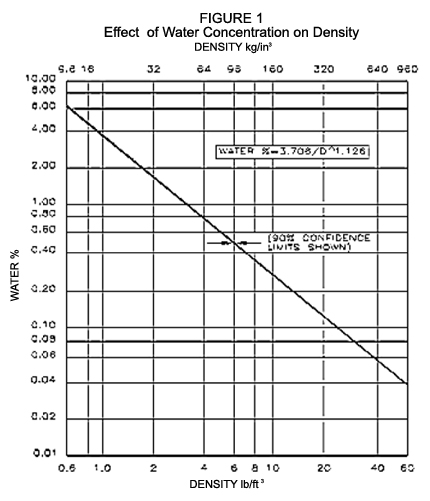
A common method used to obtain a change in load capacity is a change in density. At Piping Technology and Products, we offer 10 lbs. / ft3, 14 lbs. / ft3, and 20 lbs. / ft3 densities.
Density varies when the amount of blowing agent (water content) changes. The density of polyurethane decreases with increase in water content (See Fig. 1). This relationship can be shown as follows:
W = 3.706 / D1.126
Where: W = % of water content
D = Density of foam (lbs./ft3.)
In addition to density, the strength of a rigid urethane foam is also influenced by many factors such as catalyst, surfactant, type of mixing, the type of foaming system: base polyol and isocyanate, and the influence of each of these on the foam cell structure.
Rigid urethane foams generally have an elastic region in which stress is nearly proportional to strain. They do not exactly follow Hooke’s Law (stress is proportional to strain) because the curve is very slightly “S” shaped. Fig. 2 shows this in detail.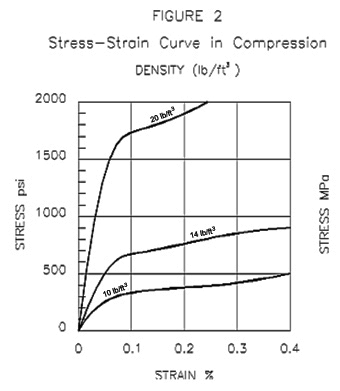
Polyurethane is anisotropic, or polyurethane is stronger in the direction of foam rise. At Piping Technology and Products, the anisotropic character or directional properties of our polyurethane is reduced by overloading the mold used to form the polyurethane. By overloading the mold, we can control the cell structure and provide uniform physical properties. A relationship between compressive strength and the density of the foam is given in Fig. 3.
Polyurethane is a thermosetting material; however, it does soften slightly with increased temperature and hardens somewhat at very low temperatures. Softening at high temperatures affects the polyurethane in two ways: (a) loss of strength properties and (b) change in foam dimensions (particularly low-density foams). Low temperatures generally have a very little effect on polyurethane properties other than to make them a little harder and more brittle. See Fig. 4 for these effects.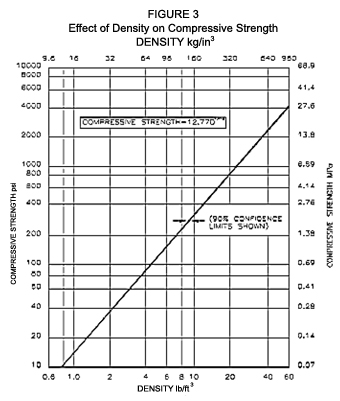
Rigid polyurethane foams have a relatively large amount of cross-linking as the foam expands. Our suppliers of the raw chemicals control the degree of cross-linking by functionality (higher functionality produces more cross-links) and molecular weight of the components in the blend. The rigid cells provide the poured foam with strength and the interior space provides low thermal conductivity. Water is used as the blowing agent for foam in this 10 to 40 lb. density range.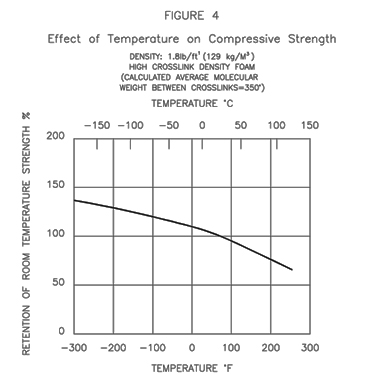
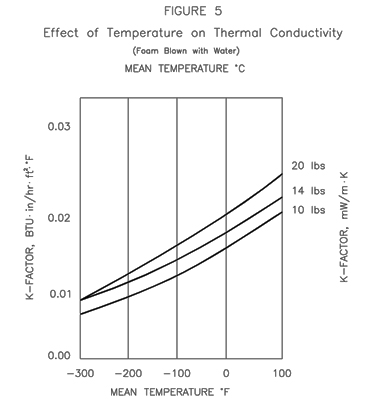
The relationship between temperature, thermal conductivity and the density of polyurethane foam is shown in Fig. 5.
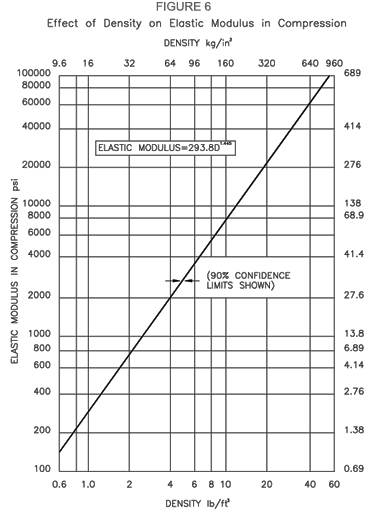
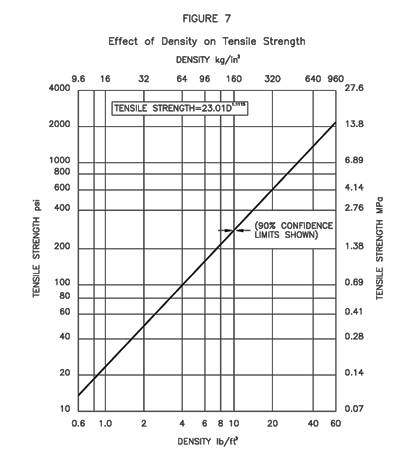
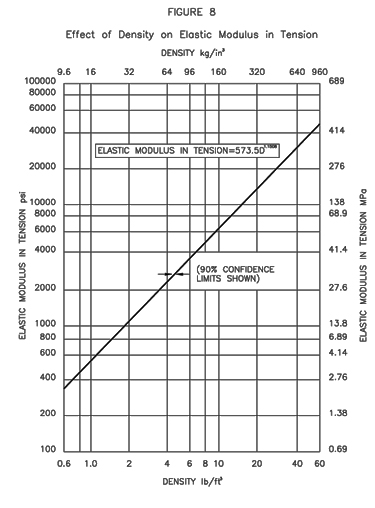
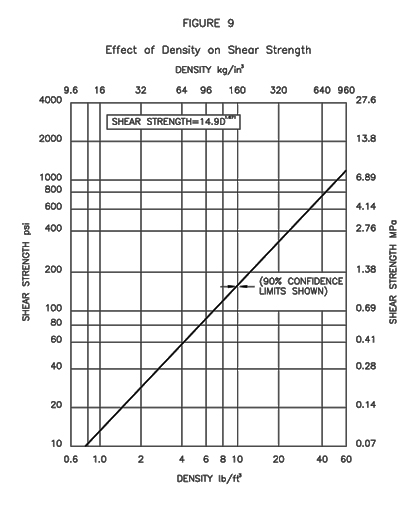
The relationships of foam’s density with its elastic modules in compression, tensile strength, elastic modules in tension, and shear strength are given in Figs. 6 through 9, respectively. Please see the following for the respective curves.
Piping Technology & Products has a complete manufacturing facility for the production of polyurethane required for pipe supports. We invite our customers to visit our facility and observe the fabrication of insulated pipe supports of all types.
| PUF (10lb/cuft) | 200.00 | 400.00 | 300.00 | 6,000.00 | 95.00 | -300.00 | 0.08 | 0.1600 | 180.00 | 0.1157 | 0.22 |
| PUF (14lb/cuft) | 300.00 | 600.00 | 500.00 | 11,000.00 | 95.00 | -300.00 | 0.12 | 0.2000 | 200.00 | 0.1736 | 0.18 |
| PUF (20lb/cuft) | 500.00 | 1,100.00 | 600.00 | 20,000.00 | 95.00 | -300.00 | 0.14 | 0.2500 | 400.00 | 0.2893 | 0.13 |
Q: What is the primary advantage of using PUF insulation in pipe supports?
A: The primary advantage of PUF insulation is its high strength-to-weight ratio and excellent thermal resistance. It serves a dual purpose: it acts as a durable structural component that supports pipe loads, while also providing a thermal barrier that resists heat transfer better than many alternative materials.
Q: How does PUF foam density affect the load capacity of the support?
A: There is a direct relationship between PUF foam density and compressive strength. Higher-density foam (measured in lbs/ft³) can support heavier piping loads without crushing. For example, a 10 lb/ft³ foam will have a significantly lower compressive PSI rating than a 20 lb/ft³ or 30 lb/ft³ foam.
Q: Why is the polyurethane foam structure described as “closed-cell”?
A: The polyurethane foam structure is “closed-cell” to prevent moisture ingress. It is composed of sealed, microscopic bubbles that trap gas and prevent moisture and air from passing through. If the foam were open-cell, it would absorb water or moisture, which would freeze in cold applications, reducing its insulating value and potentially damaging the pipe. The closed-cell structure ensures the piping foam remains impermeable and thermally efficient.
Q: Is PUF suitable for high-temperature applications?
A: Generally, PUF is best suited for cold and cryogenic applications (down to -265°F and below) and moderate ambient temperatures. While rigid PUF insulation can tolerate elevated temperatures, its maximum service temperature is much lower than that of materials such as calcium silicate. It is one of the industry standards for cold shoes.
Q: How do I specify the correct polyurethane density for my project?
A: To specify the correct polyurethane density, you must calculate the total load at the support point (pipe weight + fluid + insulation + cladding) and the area of the shoe. The selected polyurethane density must provide a compressive yield strength that exceeds the calculated load pressure, typically with a safety factor.